
How fair rental value is defined and calculated on a claim, the role insurance housing companies play, and why the market gets the final word.
A companion to our risk-premium framework for insurance housing. That paper showed how quotes on insurance placements anchor to the insured's housing allowance instead of the market. This one goes a level deeper and asks where the allowance itself comes from: how fair rental value is defined in policies, the methodologies carriers and insurance housing companies use to calculate it, and why, whatever the paperwork says, the market gets the final word on what an alternative stay costs. One note before we start: this is market education, not coverage advice. Policy language varies by form, state, and carrier; for questions about a specific claim, the policy itself and resources like United Policyholders are the right sources.
If you only have five minutes, read the bold sentences and the FAQ.
Fair rental value is the amount a property would command in rent on the open market under current conditions. In homeowners policies it appears inside loss-of-use coverage (commonly Coverage D), alongside additional living expense; in dwelling policies it can be its own coverage. Adjusters establish it by surveying comparable rental properties, and it can serve as the basis for paying a displaced family's temporary housing.
That definition sounds simple. The interesting part - and the reason this piece exists - is what happens between the definition and a real family needing a real furnished home by Friday.
The first thing to understand about fair rental value is that the term does more than one job, and the jobs are frequently confused.
Job one: replacing a landlord's lost rent. In the standard homeowners form, loss-of-use coverage bundles two benefits: additional living expense (ALE), which covers the policyholder's own increased cost of living somewhere else, and fair rental value, which replaces lost rental income when a rented portion of the property becomes uninhabitable (IRMI; legalclarity.org). In dwelling policies written for rental property, FRV stands as its own coverage. In this job, FRV is a landlord's benefit, paid on market rental value rather than the actual rent charged, with expenses that cease during the vacancy (utilities, for instance) deducted (IRMI).
Job two: the basis for loss-of-use itself. On some policies, temporary living coverage is defined in FRV terms. California FAIR Plan policyholders, for example, have loss-of-use coverage based on the fair rental value of the dwelling (United Policyholders).
Job three: an electable way to pay a displaced family. Many policies contain a provision letting the insured take the reasonable rental value of the damaged premises instead of documenting itemized expenses. One wildfire survivor describes the mechanics exactly: the insurer performed "a market analysis of the current monthly rent for a furnished home comparable to our destroyed home" and multiplied it by the policy's ALE time limit (United Policyholders, Survivors Speak). One monthly number, no receipts.
The jobs differ, and the law can treat them differently (California's post-disaster ALE extensions, for instance, address ALE without mentioning FRV; United Policyholders). But notice what all three share. In every job, fair rental value is a market number: what a comparable home actually rents for, right now. Which means everything depends on how well anyone can observe that market.
Two inputs shape a temporary-housing budget on a claim, and it helps to keep them separate.
The insured value of the property sets the ceiling. Loss-of-use coverage is typically capped as a percentage of the dwelling coverage, commonly cited between 10% and 30% depending on the form and carrier with 20% a frequent default (legalclarity.org; stillinsurable.com), and usually paired with a time limit in the 12-to-24-month range (strongadjusters.com). So a $500,000 dwelling at 20% implies a $100,000 loss-of-use pot. That is a budget ceiling derived from the insured value. It is not, and was never meant to be, a statement of what housing costs.
Market comps set the number. Within that ceiling, adjusters establish fair rental value by pulling comparable rentals: commonly three to five properties in the same area, matched on square footage, bedroom count, condition, and amenities (legalclarity.org). For a displaced family the comp that matters is a furnished home of like kind and quality, which is a thinner, harder-to-observe market than ordinary rentals. This is where insurance housing companies earn their seat: supporting adjusters with the comping, sourcing the comparable furnished home, and managing the placement itself.
In brief: the insured value sets how much budget exists; the comps decide how much of it gets spent. Every failure mode in this market lives in the second step.
Here is the part the paperwork can't change. Whatever FRV a methodology produces, the displaced family still has to live in an actual home, and the price of that home is set by the market at the moment of the loss. Not by the policy, not by the heuristic, not by the comp file.
Now put the pieces together, because this is where the astronomical-rate stories come from, and they come from two directions at once:
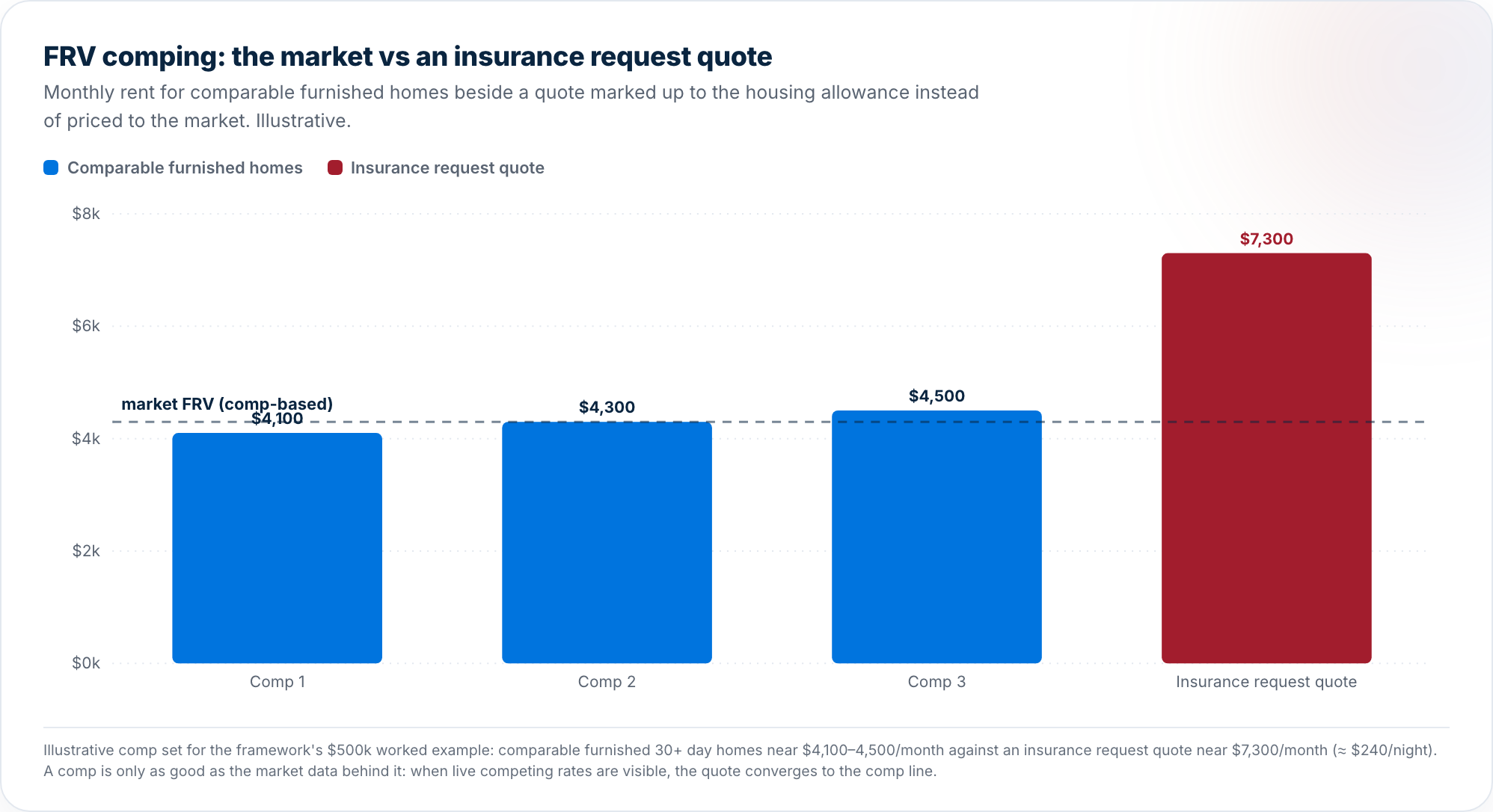
As a principle: a comp is only as good as the market data behind it. When the market is invisible, the comp becomes a negotiation; when the market is visible, the comp becomes a fact.
The result is the pattern we documented in the framework paper's worked example: placements quoting above the short-term nightly rate for a comparable home. That is an inverted term curve, and cost structure cannot produce it. A 60-day committed stay pricing above a weekend stay is not scarcity. It is structure.
Follow the logic to its end and the conclusion writes itself. Fair rental value is, by definition, a market-observation exercise. The quality of the number is exactly the quality of the observation. For decades, observing the furnished 30+ day market meant calling around: no live rates, no live availability, no way to know whether a quote was the market or an opinion about a budget.
A real-time marketplace changes what a comp is. When comparable furnished homes list live availability at live, bookable rates, the comp set stops being a stack of stale asking prices and becomes a set of prices someone can actually transact at, today. That serves everyone in the chain honestly: adjusters and insurance housing companies get an FRV they can defend, carriers get a budget grounded in something checkable, hosts get placements won on rate rather than on information asymmetry, and the displaced family gets a home priced like a home instead of like an allowance.
Real FRV comping was never a methodology problem. It was a visibility problem. The methodology (compare the home to its true peers) has been right all along. What was missing was a market transparent enough to compare against.
(For context on who we are: Radius is a real-time marketplace for 30+ day furnished accommodations, serving insurance, corporate, and direct guests, with an 8-11% booking fee deducted from the host's payout. Hosts list live availability at their own rates; companies book directly from the live calendar.)
The honest caveats. Policy structures vary widely: the coverage percentages, time limits, and whether FRV is electable differ by form, state, and carrier, and the figures cited here are commonly referenced ranges, not a survey of the market. We also can't quantify how often FRV elections are used versus itemized ALE, or how large the comp-quality gap is on a typical claim; the sources here are policy references and documented survivor accounts, not claims data. And nothing in this piece is coverage advice. For a specific claim, the policy controls, and consumer resources like United Policyholders exist precisely for those questions.
We're passing this framework along for you to take or leave, and to stress-test. If you adjust claims or run placements and see this differently, we want to hear it.
What is fair rental value in homeowners insurance?The amount a property would command in rent on the open market under current conditions. It appears in loss-of-use coverage alongside additional living expense, replaces lost rental income for rented portions of a property, and on some policies serves as the basis for paying a displaced family's temporary housing.
How do adjusters calculate fair rental value?By market comparison: typically pulling several comparable rental properties in the same area, matched on square footage, bedroom count, condition, and amenities. For displaced families the relevant comparable is a furnished home of like kind and quality. Insurance housing companies often support adjusters in building these comps and sourcing the placement.
Is fair rental value the same as additional living expense (ALE)?No. ALE reimburses the policyholder's own increased costs of living elsewhere (rent, mileage, and similar expenses incurred because of the loss). Fair rental value is a market-rent figure: it replaces a landlord's lost rental income, and on some policies it can serve as the basis or an electable substitute for ALE. Some policies and laws treat the two differently.
Can a policyholder take FRV as a monthly payment instead of submitting receipts?Some policies allow electing the reasonable rental value of the damaged home in place of itemized expense reimbursement: one monthly payment based on a market analysis of comparable furnished rent. Whether that option exists, and how it's calculated, depends on the specific policy.
Why are insurance housing rates sometimes so high?Two forces stack. After a catastrophe, real scarcity in furnished family-sized homes pushes real prices up. On top of that, when suppliers can see the housing budget and buyers can't see competing inventory in real time, quotes anchor to the allowance rather than the market. The second force is structural and disappears when comparable rates are visible in real time.
Related reading: the risk-premium framework for insurance housing · why is corporate housing so expensive? · why aggregators don't solve insurance housing · why 90% of insurance stays get extended
Book a 30+ day furnished stay, or list a property and reach insurance, corporate, and healthcare demand on one platform.

The Only Real-Time Marketplace Exclusively for 30+ Day Stays
© 2026 Radius. All rights reserved.
The only real-time marketplace exclusively for 30+ day stays.