
Where a corporate housing rate actually comes from: the RMC-to-owner supply chain, what each layer adds, and what the same unit costs built from real costs.
A companion to our risk-premium framework for insurance housing and to Part 2 and Part 3 of the series. Those pieces established that every era of this industry added a layer between the buyer and the person who holds the keys. This one walks the corporate housing chain specifically: who each layer is, what it adds, what it charges, and what the same apartment costs when you build the rate from real costs instead. One thing to be precise about up front: the markup mechanics described here belong to corporate housing. Insurance housing carries a different distortion, and we keep the two separate.
If you only have five minutes, read the bold sentences and the two tables.
Because the rate usually passes through a chain of intermediaries before it reaches the multifamily operator or owner who actually holds the apartment. A relocation management company, a sourcing platform, a national provider, and a regional provider can each sit in the same transaction, and each prices in its own margin. The furnishing, utilities, and service that justify a premium cost far less than the chain adds.
That is the short answer. The rest of this piece walks the chain one layer at a time, then rebuilds the rate from real costs so you can see the difference.
Here is the fullest version of the corporate housing supply chain, from the company paying to the person who holds the keys:
Employer / relocating company → RMC → sourcing platform or aggregator → national corporate housing provider → regional provider → multifamily operator / owner
Not every placement passes through every layer. Some companies buy direct from a national provider; some placements skip the platform; some skip the RMC. But the full chain is common enough to walk in order, and each link deserves a fair description of the work it does, because every layer in this chain exists for a reason. The problem is not that the layers are useless. The problem is that they stack.
The relocation management company (RMC). The employer's outsourced mobility department: policy administration, household goods, destination services, and temporary living among them. The temporary-living component gets sourced from housing suppliers, and the documented industry norm is a spread or supplier commission layered on the pass-through cost of the housing itself (UrbanBound).
The sourcing platform or aggregator. Platforms like 3Sixty sit between RMC demand and supplier inventory: suppliers list or bid, buyers search and transact (Landing; 3sixty.tech). Part 3 covered this layer in depth: it solves discovery, polices quotes against market benchmarks, and is structurally positioned to earn in the gap between what the buyer pays and what the supplier receives.
The national corporate housing provider. A brand with coast-to-coast coverage that a Fortune 500 or an RMC can contract once. Where the national provider doesn't operate its own units in a market, it fulfills through the next layer down.
The regional provider. The local operator who actually knows the buildings: which multifamily communities take furnished units, what the market rate is, who has availability. Often the one who leases the apartment, furnishes it, and services the stay.
The multifamily operator / owner. The person who holds the keys: an apartment community leasing an unfurnished unit at its ordinary market rent, or a local owner-operator. This is where the real asset and the real base cost live.
Walk the chain backward and the arithmetic writes itself: the owner's rent is the base; the regional provider adds furnishing, service, and margin; the national provider adds coverage and margin; the platform adds discovery and margin; the RMC adds administration and margin. Four margins on one apartment. That's the whole trick.
Part 3 cited the concrete version of this: a unit the inventory owner offers at around $140 a night reaching the end buyer at around $240 a night, roughly a 71% increase, because of the two or three layers sitting between demand and supply. (As with every use of this figure: it comes from an industry conversation in 2026 and illustrates how markup layers stack. It is not a published statistic, not a rate card, and not a guaranteed-savings claim.)
This figure belongs to the corporate housing chain, the one walked above. Here is how it accumulates:
| Layer | What it contributes | What happens to the rate |
|---|---|---|
| Multifamily operator / regional provider | The unit, furnished and serviced, at its real rate | ~$140/night |
| National provider | Coverage, account management | + margin |
| Sourcing platform / aggregator | Discovery, transaction, benchmarking | + margin |
| RMC | Policy administration, coordination | + spread or supplier commission |
| What the employer's program pays | ~$240/night |
(Illustrative allocation only. We are not asserting any specific layer's take, and in a given deal some layers are absent. The point is structural: each intermediary prices in its own margin, and the buyer pays the sum.)
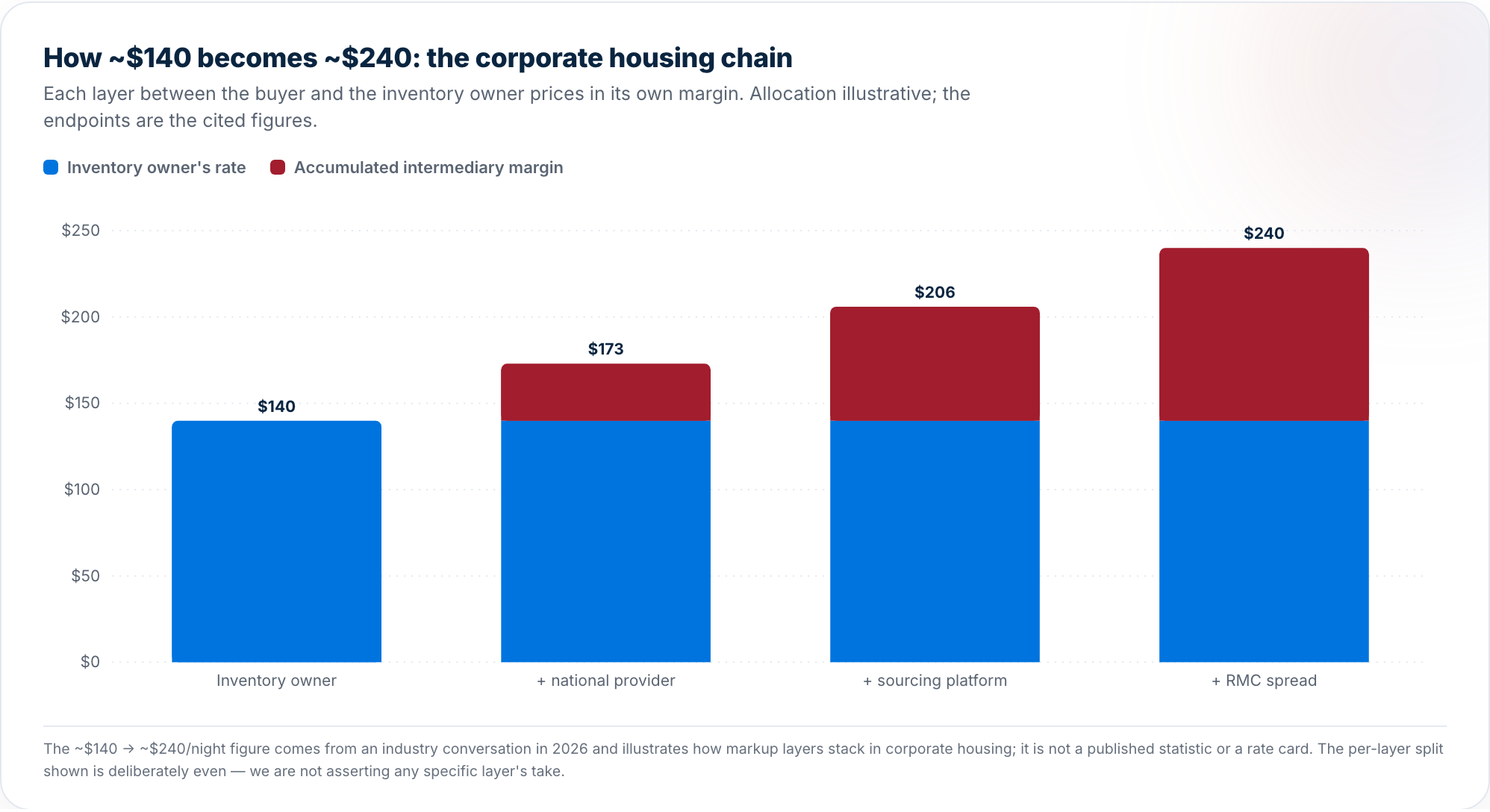
Now build the same rate from the ground up, the way the risk-premium framework does for insurance housing. What does furnishing an apartment actually cost?
Furniture rental is a real, quotable market, which makes it the perfect anchor for the biggest "furnished premium" component. CORT, the largest furniture rental company in the country, publishes its package pricing: a one-bedroom furniture package starts around $240–295 a month on a 12-month lease depending on the city (CORT). Larger homes build up from there through added bedrooms, office, appliances, and housewares; as an illustrative range, a large multi-bedroom home runs toward $1,000 a month. (Note, in passing, that even furniture rental has a term curve: shorter terms price higher per month than a 12-month lease. Hold that thought; it matters in the insurance piece.)
Add housewares, add bundled utilities and internet (a few hundred dollars a month), add the operational cost of move-in coordination and mid-stay service, and add a fair margin for the operator doing that work honestly. Stack those on a $2,000–2,500 market-rent apartment and you get a furnished, serviced unit in the range of $3,500–4,500 a month, roughly $115–150 a night. Which is exactly the neighborhood where the $140 figure began. The inventory owner's rate already contains the full honest cost of a furnished stay. Everything between $140 and $240 is chain, not cost.
As a principle: when the bottom layer's price already covers every real cost, everything above it is paying for the structure of the market, not the product.
It would be convenient to tell one markup story about the whole midterm market. It would also be wrong, and the difference matters for anyone trying to fix either one.
Corporate housing inflates through layer-spread stacking. Every party in the chain can see market rates reasonably well; the inflation comes from the number of hands the transaction passes through. The buyer is a professional procurement function, the demand is planned, and the margins are quiet but structural. Note also who owns the asset: the multifamily building appreciates for its owner, and every corporate housing layer above it holds no asset at all. Layer earnings are spread, not return - which is exactly why the layers defend the spread.
Insurance housing shares the layering only where layers exist, and adds a distortion corporate housing doesn't have: insurance request markup. The demand is urgent, the placement is per-claim, and when a supplier can see the insured's housing allowance, quotes anchor to the allowance rather than to competing inventory. The risk-premium framework quantifies both components in basis points, and the fair rental value piece explains where the allowance itself comes from.
Conflating the two leads to bad fixes. Benchmarking tools help police corporate spreads but don't remove layers; process reform at insurance housing companies improves workflows but doesn't remove the information asymmetry. The structural fix for both is the same, and it is the one thing neither chain has had: the inventory owner's real rate, visible in real time, next to its competition.
A real-time marketplace collapses the chain to one hop: the multifamily operator or regional provider lists live availability at their own rate, and the company books it directly. Radius charges an 8-11% booking fee, deducted from the host's payout; there is no reseller between the rate and the buyer to stack a margin on it. The professionals in the chain don't disappear. RMCs still run mobility programs, and providers still furnish and service units. What disappears is the space between them where the margins stacked.
The honest caveats. We can't quantify what share of corporate placements traverse the full four-layer chain versus a shorter one; the $140→$240 figure is one cited example, not a distribution. Layer-by-layer margin data is private, and the allocation table above is deliberately unallocated. And furniture rental pricing varies by market and package; the ranges here are anchors, not quotes. If you operate in this chain and your numbers differ, we want to see them. That's why we publish the framework rather than just the conclusion.
(For context on who we are: Radius is a real-time marketplace for 30+ day furnished accommodations, serving insurance, corporate, and direct guests, with an 8-11% booking fee deducted from the host's payout. Hosts list live availability at their own rates; companies book directly from the live calendar.)
Why is corporate housing so expensive?Mostly market structure. The rate often passes through a relocation management company, a sourcing platform, a national provider, and a regional provider before reaching the multifamily operator who holds the unit, and each layer prices in its own margin. The real added costs of a furnished stay (furniture, utilities, service) are a fraction of what the chain adds.
How much do relocation management companies mark up temporary housing?Specific margins are private, but the documented industry norm is a spread or supplier commission layered on the pass-through cost of housing. The markup varies by contract and program; what's structural is that it stacks on top of the margins below it in the chain.
What does furniture rental actually cost?CORT's published one-bedroom package pricing starts around $240–295 a month on a 12-month lease depending on the city. Larger homes build up through add-ons; as an illustrative range, a large multi-bedroom home runs toward $1,000 a month.
Is corporate housing markup the same as insurance housing markup?No. Corporate housing inflates through layer-spread stacking along the supply chain. Insurance housing shares layering where it exists but adds a different distortion: quotes anchored to the insured's housing allowance rather than to competing market inventory.
How can companies avoid the markup?Shorten the chain. Booking the inventory owner's own listed rate on a real-time marketplace removes the reseller margins entirely; the trade is an 8-11% booking fee, deducted from the host's payout, instead of a stack of spreads. Benchmarking tools inside the existing chain police quotes but leave the layers in place.
Related reading: the risk-premium framework for insurance housing · fair rental value, explained · where corporate housing came from · why aggregators don't solve insurance housing.
Book a 30+ day furnished stay, or list a property and reach insurance, corporate, and healthcare demand on one platform.

The Only Real-Time Marketplace Exclusively for 30+ Day Stays
© 2026 Radius. All rights reserved.
The only real-time marketplace exclusively for 30+ day stays.