30+ day stays sit in a different category than nightly Airbnbs and 12-month leases. Here's how to know which one matches what you actually need.
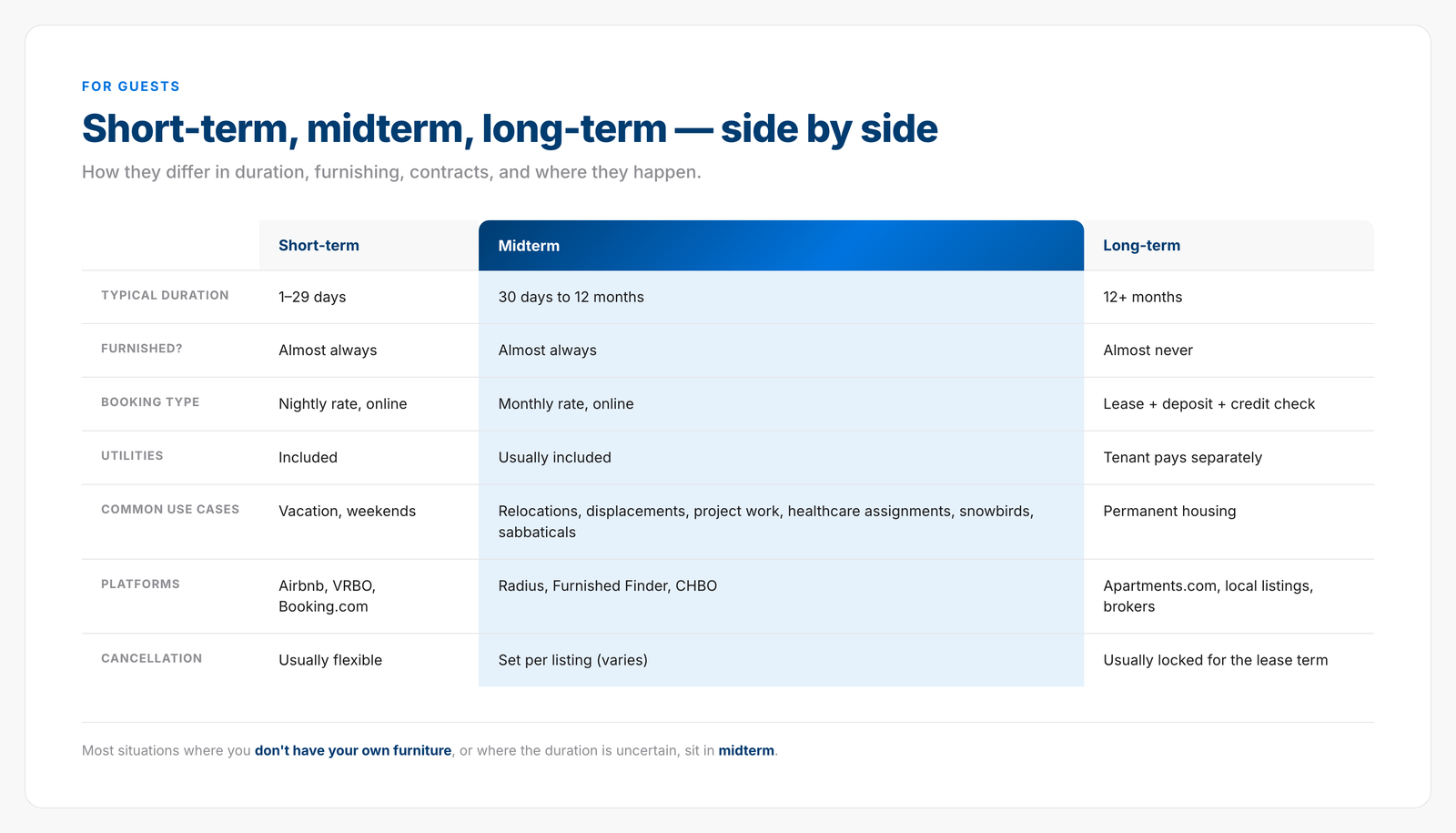
If you've started searching for a place to stay and you're not sure whether you need an Airbnb, a "midterm" rental, or a regular lease - you're not alone. The categories overlap visually but mean different things in terms of duration, furnishing, contracts, and how the booking actually happens.
If your situation is "I'm here for 2 nights for a wedding," that's clearly short-term. If it's "I'm signing a lease in this city for 5 years," that's long-term. Most other situations - especially anything where you don't have your own furniture, or where the duration is uncertain - sit in midterm.
Midterm exists because there's a real gap between nightly Airbnbs and annual leases. Specific situations where 30+ day furnished stays fit:
Relocations. You took a job in a new city. You haven't bought a house or signed a lease yet because you want to live in the area before committing. A 60–90 day midterm stay buys you that time without overpaying for a hotel or breaking a year-long lease later.
Insurance displacement. A fire, water damage, or other claim made your house uninhabitable while it's being restored. Your insurance covers furnished housing while the work happens. Midterm is what insurance housing companies place displaced policyholders into.
Project travel and corporate housing. Your employer sent you to a different city for a 90-day implementation, training rotation, or temporary assignment. Hotels burn the budget; an Airbnb at nightly rates doesn't have a kitchen or workspace; a regular lease isn't an option for that timeline.
Healthcare staffing. If you're a travel nurse, allied health worker, or traveling physician, your assignments are typically 13 weeks (91 days). Midterm is built for this - extension-friendly listings, agency-paid arrangements, and turnkey furnished spaces near hospitals.
Sabbaticals and slow-travel. You're spending 1–6 months in a new city to write, work remotely, or just live somewhere else. You want a full kitchen and a workspace, not a hotel room.
Snowbirds and seasonal stays. You spend winters in Arizona and summers in Maine. Each season is a 3–5 month stretch - clearly midterm.
Between homes. You sold your house, you're closing on a new one in 4 months, and the timeline doesn't quite work. Midterm is the bridge.
The 30-day cutoff isn't arbitrary. It's regulatory and operational:
Regulatory. Many cities define "short-term rental" as anything under 30 days and apply heavier rules - occupancy taxes, registration, primary-residence requirements, hard caps on the number of nights per year. 30+ day stays are usually exempt from STR rules and treated more like leases.
Operational. A 30-day stay is one turnover; ten 3-day stays are ten. That changes the host's cost structure, so midterm is priced and sold differently - a monthly rate with utilities usually bundled in, rather than a nightly rate plus fees. What it does not mean is that midterm is cheap. A 30-day furnished stay usually runs only modestly below a comparable nightly rate - not a fraction of it - because furnished midterm supply is far thinner than nightly supply, which keeps rates firm. The real difference isn't a discount; it's what you're buying: a longer, settled, furnished place to live.
Tax. Hotel and transient occupancy tax rules change with the length of stay, and the threshold varies by state and city. Check the local rules before you compare prices.
Together, those three things create a different category of rental - one where the listing, pricing, and booking workflow are all built around a longer horizon.
If you've decided midterm is right, the things to evaluate aren't quite the same as for a nightly Airbnb:
Workspace. Midterm guests often work remotely. A real desk (or at least a usable kitchen-table workspace) matters more than a hot tub.
In-unit laundry. Going to a laundromat once on a 3-night stay is fine. Going twelve times on a 90-day stay isn't.
Utilities included. Midterm listings should bundle Wi-Fi, electricity, water, and gas into the monthly rate. If they don't, factor that into the comparison.
Extension policy. If there's any chance you'll need to stay longer than originally booked (relocations and insurance claims especially), filter for extension-friendly properties before you book.
Refund policy. Each listing uses one of two refund policies, set by the host: Firm (the default) or Strict. Under Firm, you can cancel for free 30 or more days before check-in. Under Strict, free cancellation applies only within 48 hours of booking, and only when check-in is 28 or more days away. Check before booking.
Real-time availability and rates. A listing that takes a week to confirm a quote isn't built for midterm search specialists; pick listings that book in real-time (the rate you see is the rate you pay).
Three paths depending on who's paying:
You're paying yourself (direct guest). Search → pick → book → confirm. The 8-11% booking fee is paid by the host (deducted from their payout); you see the listed rate as your total cost. Cancellation terms depend on the listing's policy, set by the host.
Your insurance company is paying (because of a claim). Your insurance housing company places you. They have a search specialist who searches Radius for extension-friendly properties in your area, builds a shortlist, and shares it with you. You pick. They book.
Your employer is paying (relocation or project travel). Your relocation team or RMC places you. Same workflow as insurance - they handle the search and booking, you handle the picking.
Whichever path, the listing rate is the same, the booking is on-platform end-to-end, and the host is paid out automatically.
If you need a place for under 30 days, it's short-term - Airbnb is your platform. If you need a place for 12+ months and you have your own furniture, it's long-term - sign a lease. Anything in between is midterm. That's where Radius lives.
Book a 30+ day furnished stay, or list a property and reach insurance, corporate, and healthcare demand on one platform.

The Only Real-Time Marketplace Exclusively for 30+ Day Stays
© 2026 Radius. All rights reserved.
The only real-time marketplace exclusively for 30+ day stays.