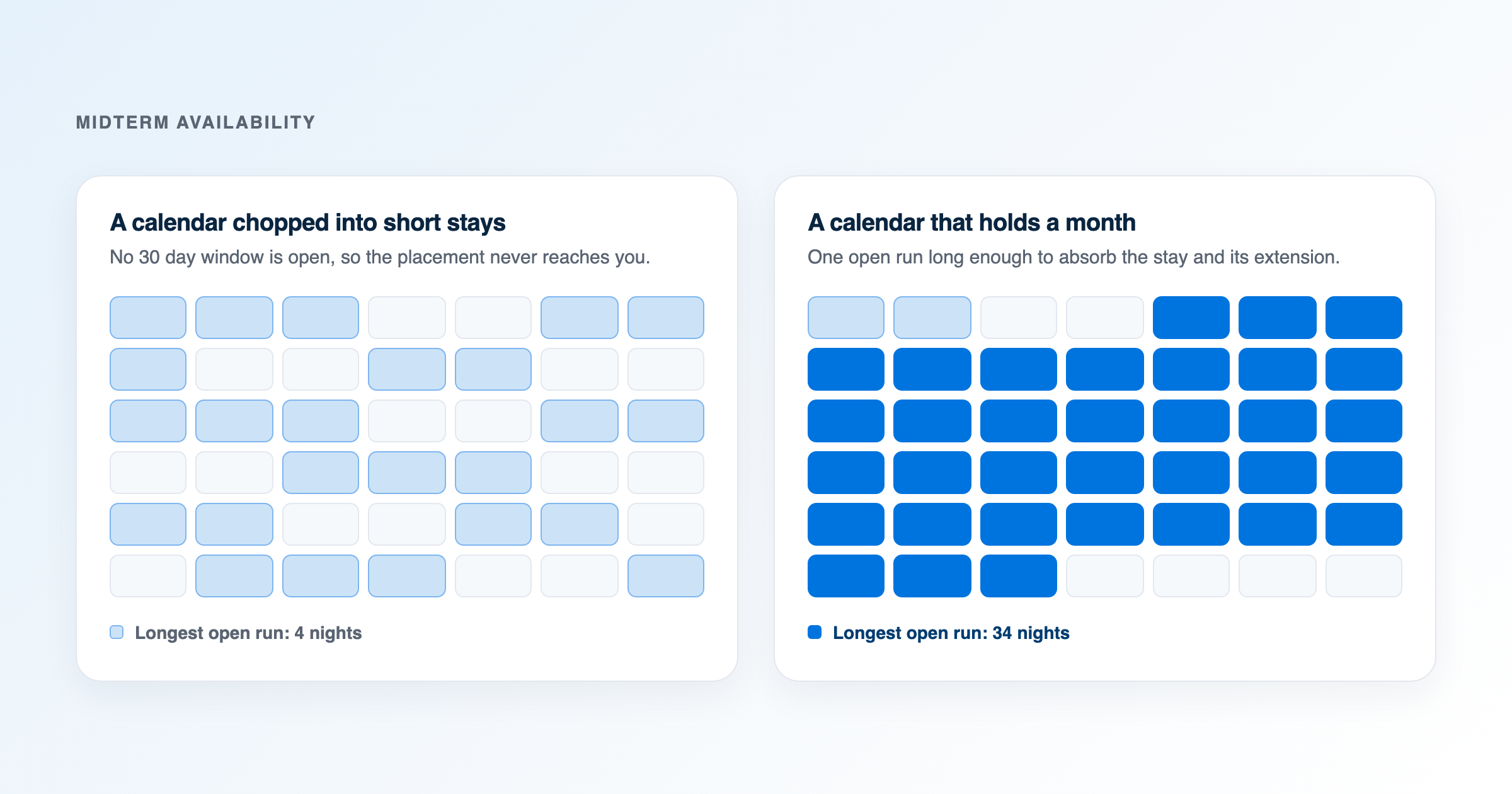
If midterm bookings are not reaching you, the cause is rarely price. Your calendar never looked available to the people placing the stay.
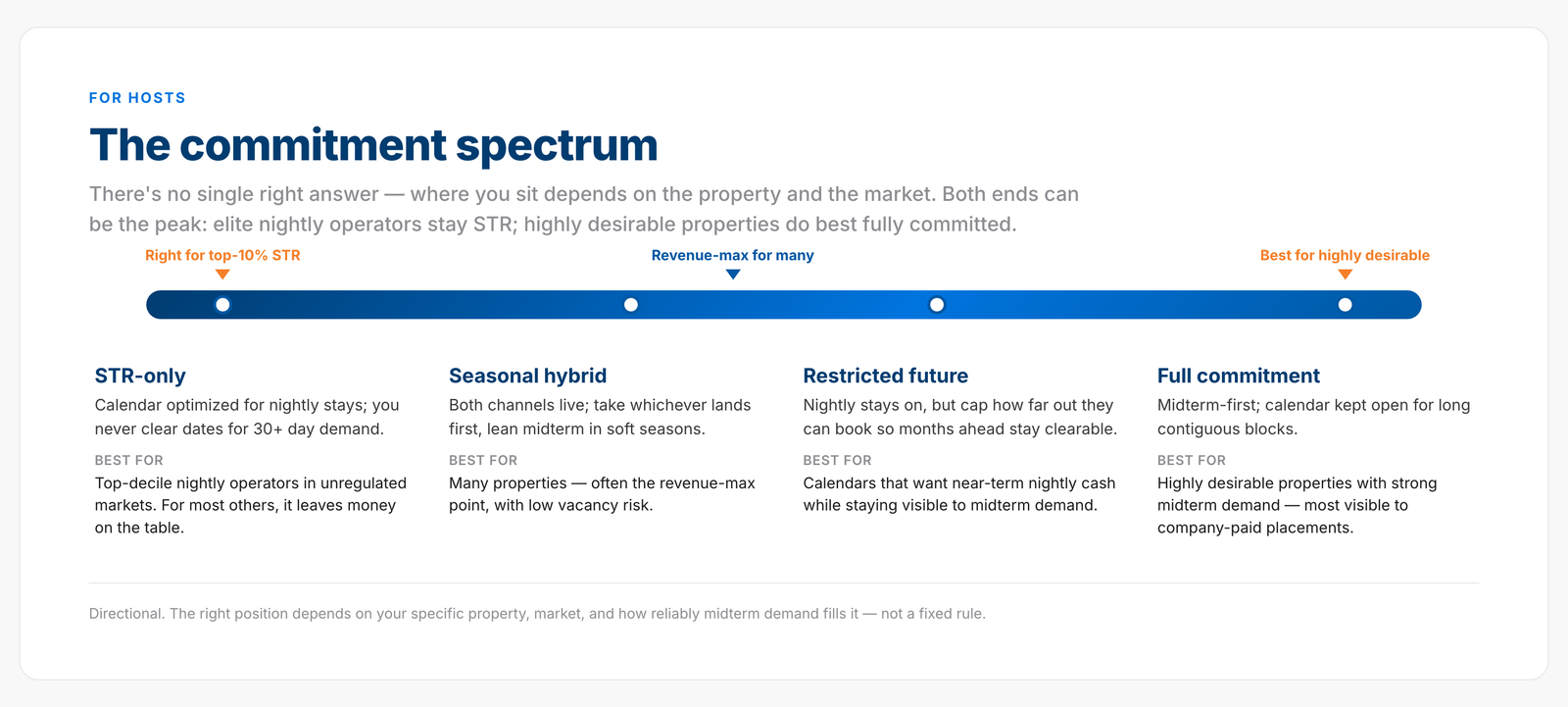
This isn't a pitch to go all-in on midterm. It's an explanation of a mechanic you may never have seen, and a map of where your specific property makes the most money - which, for a lot of properties, is not full commitment.
Here's the mechanic. The companies placing 30+ day stays - insurance housing companies, relocation teams, corporate travel - don't browse. Their search specialists filter for properties that can actually take the block, then place. If your next 90 days are diced into three- and seven-night holds, you don't lose the bid - you were never in it. The opportunity came and went and you never saw it. So "I don't get midterm bookings" is, most of the time, "my calendar never looked available to the people who place them."
The reason this is worth your attention at all: furnished, 30+ day, extension-friendly supply is genuinely scarce next to nightly supply. Thin supply does two useful things at once - it keeps rates from collapsing the way nightly rates do in a soft season, and it means search specialists are working from a short list. Being on that short list is mostly a function of availability, not price.
Short-term vs. committed midterm: thin competing supply is the engine - it holds the rate and fills the calendar in long, contiguous blocks. The win is steadier utilization, not a cheaper rate.
Sitting on an empty calendar waiting for a maybe-midterm booking feels worse than watching nightly bookings roll in now. That feeling is real, and it may be the reason you keep short-term on. Nobody enjoys staring at dead dates on a bet. So let's be straight: the goal isn't to white-knuckle vacancy hoping a 90-day stay shows up. It's to be visible to that demand while protecting yourself from dead air - which is exactly what the middle of the spectrum is for.
Where you should sit isn't "all the way right." It's wherever your specific property and market maximize revenue - and for a lot of properties that's the middle, not full commitment. The spectrum is a map, not a sales funnel.
Calendar optimized for nightly. You won't see midterm requests because you never clear as available for them. Fine if you're a top-decile nightly operator in an unregulated market. For other properties, it can leave money on the table.
Same unit, both channels, calendar synced - take whichever lands first. A 60-day stay that beats a 5-night weekend is more revenue with far less turnover, and you're not staring at dead dates because nightly still fills the gaps. For many properties this is the revenue-maximizing point, full stop. Shoulder and low seasons vary by location. Peak season in Aspen is different from peak season in Florida. These slower months are an opportunity for midterm stays. A month-to-month stay booked in a slow month can extend into peak season.
Keep nightly, but cap how far out it can be booked so the months ahead stay clearable for a long block. You capture near-term nightly cash and stay visible to the company-paid demand. Best of both for a lot of calendars.
Midterm-first. Highest predictability and lowest turnover, and the strongest position for insurance/corporate placements - but only worth it if your market's midterm demand reliably fills it. For some properties this wins; for others it under-earns versus the middle. Know which you are before you go here.
Being more available is not the same as being cheaper. Midterm isn't half-price. The gap to a comparable nightly rate is shallow for a one-month stay and only deepens with length of stay - and it's capped, because the thin supply above is exactly what holds rates up.
Real-world anchor: in Austin, independent market data (AirDNA / AirROI, trailing 12 months to May 2026) put short-term ADR around $266–$288 against a median furnished nightly near $187 - and that ~30–35% gap is the deep end (long stays; median-vs-mean math overstates it), not the typical case. A one-month booking sits far closer to nightly pricing than that. You're trading turnover and vacancy risk for steadier revenue - not trading rate for it.
Find your spot on the map. If you're seasonal or not ready to stare down vacancy, start at seasonal hybrid: sync the calendar, keep month-to-month on, keep nightly on. A month-to-month booking holds your calendar for 120 days past the end date, so the stay can extend. A fixed-term booking holds no dates past the end date. Watch how fast the long blocks fill. If they fill fast and predictably, tighten the window (restricted) or commit. If they don't, you've lost nothing - nightly was still running. The point was never to convert you. It was to make sure the demand can actually find you, and to let your numbers decide where you stop.
Related: Why insurance housing bookings go to Hosts who commit to the model · Why midterm beats short-term · Midterm vs short-term vs long-term
Book a 30+ day furnished stay, or list a property and reach insurance, corporate, and healthcare demand on one platform.

The Only Real-Time Marketplace Exclusively for 30+ Day Stays
© 2026 Radius. All rights reserved.
The only real-time marketplace exclusively for 30+ day stays.